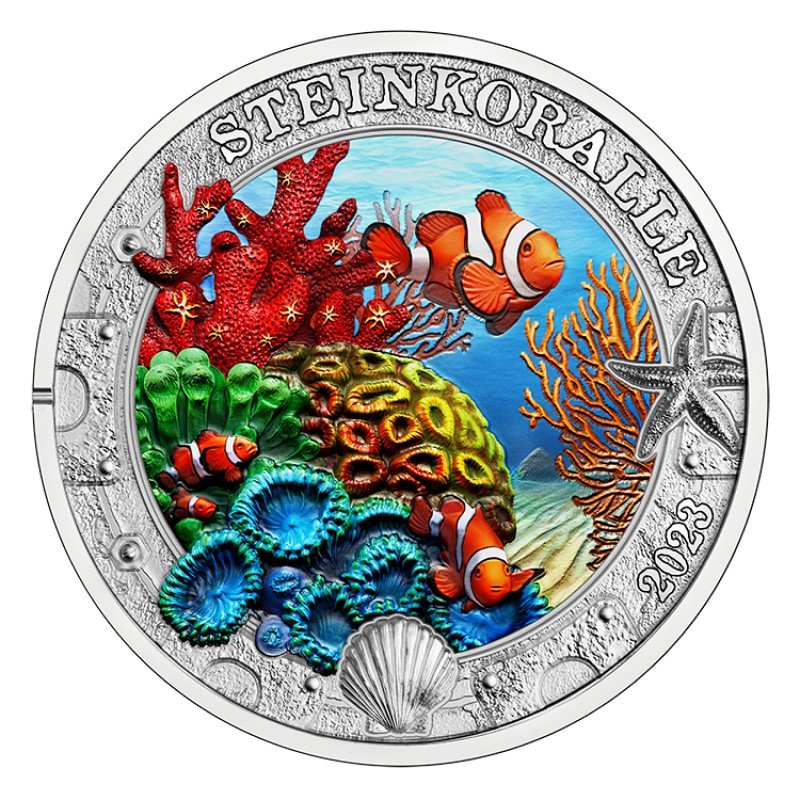


Austria 2023 3 Euro Colored Collectible Coin – Stony Corals

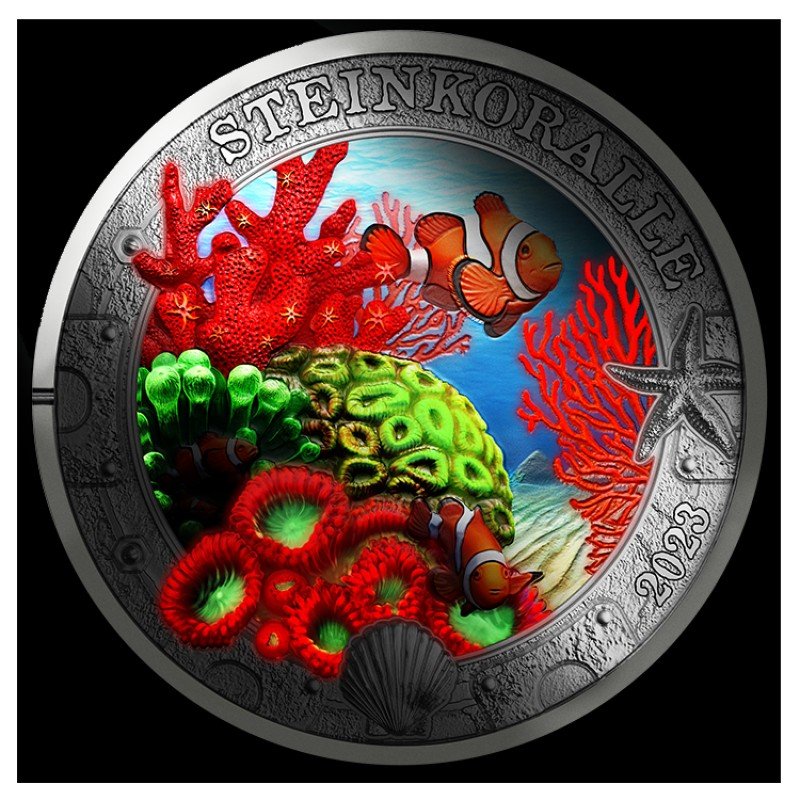
Austria 2023 3 Euro Colored Collectible Coin Glowing Under UV Light – Stony Corals.
This is the fifth coin in the “Glowing Underwater World” series.
The reverse of the coin features a wide band resembling an ancient porthole, framing a water scene with a coral reef. At the top left of the scene are stony corals, on the right are sea fans, in the center are brain corals, and at the bottom left are sea anemones, with the reef surrounded by clownfish. When the coin is illuminated by UV light, the corals and sea anemones glow and change color.
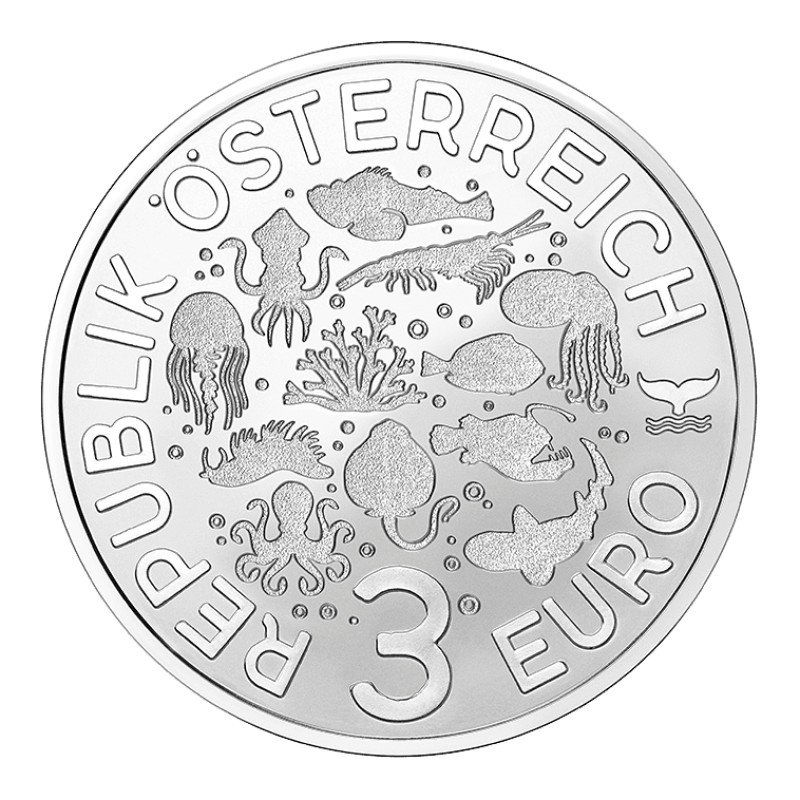
The obverse of the coin depicts silhouettes of all 12 magical sea creatures from the “Glowing Water World” series. Air bubbles rise among them, and the tail fin disappears beneath the waves on the right.
3 in stock
Scleractinians, also known as stony or hard corals, are marine animals of the Cnidaria phylum that create a hard skeleton for themselves. Individual animals are known as polyps and have a cylindrical body crowned by an oral disc, with a mouth surrounded by tentacles. While some species are solitary, most are colonial. The foundational polyp settles and begins to secrete calcium carbonate to protect its soft body. Solitary corals can be up to 25 cm (10 inches) in diameter, but in colonial species, polyps are usually only a few millimeters in diameter. These polyps reproduce asexually by budding but remain attached to each other, forming a colony of several polyp clones with a shared skeleton, which can reach several meters in diameter or height, depending on the species. The shape and appearance of each coral colony depend not only on the species but also on its location, depth, water movement, and other factors. Many shallow-water corals contain symbiotic unicellular organisms known as zooxanthellae in their tissues. They give the coral its color, which can vary depending on the type of symbiont. Stony corals are closely related to sea anemones and, like them, are armed with stinging cells called cnidocytes. Corals reproduce both sexually and asexually. Most species release gametes into the sea, where fertilization occurs, and the resulting planula larvae drift as part of the plankton, but some species brood their eggs. Asexual reproduction usually occurs through fragmentation, where part of the colony breaks off and reattaches elsewhere.
Stony corals are found in all the world’s oceans. The framework of most modern coral reefs is composed of scleractinians. Reef-building or hermatypic corals are usually colonial; most are zooxanthellate and found in shallow waters penetrated by sunlight. Other corals that do not form reefs can be solitary or colonial; some occur in deep waters where light does not reach.
| Weight | 0,02 kg |
|---|---|
| Dimensions | 0,3 × 0,1 × 0,05 cm |
| Country | |
| Year | |
| Denomination | |
| Quality | |
| Mintage |
Related products

-
Išparduota