
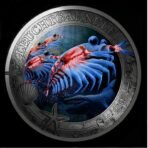
Austria 2023 3 Euro Colored Collectible Coin – Antarctic Krill

Austria 2023 3 Euro Colored Collectible Coin Glowing in UV Light – Antarctic Krill.
This is the third coin in the “Glowing Water World” series.
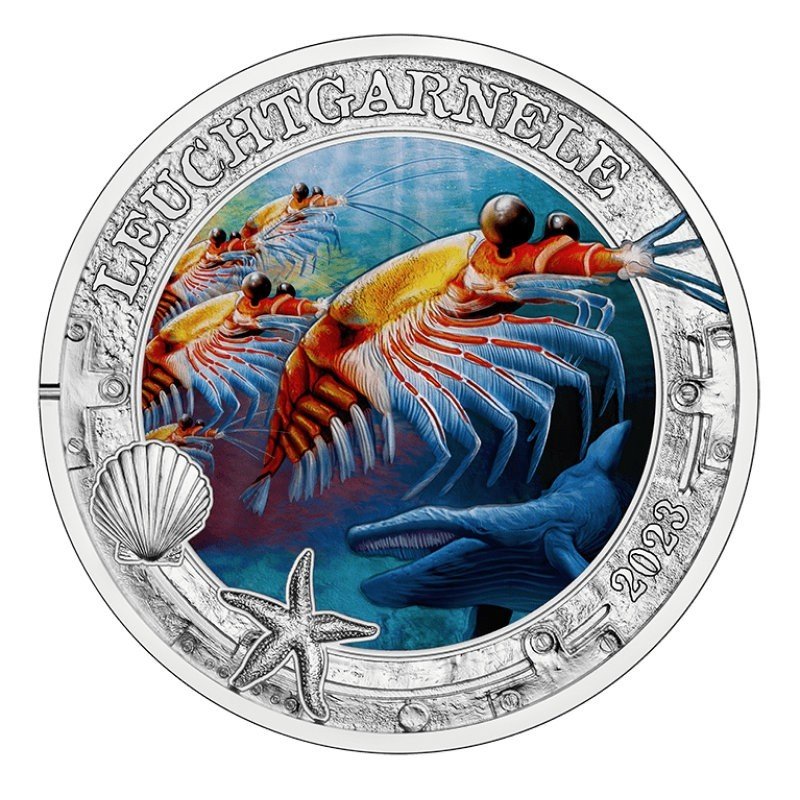
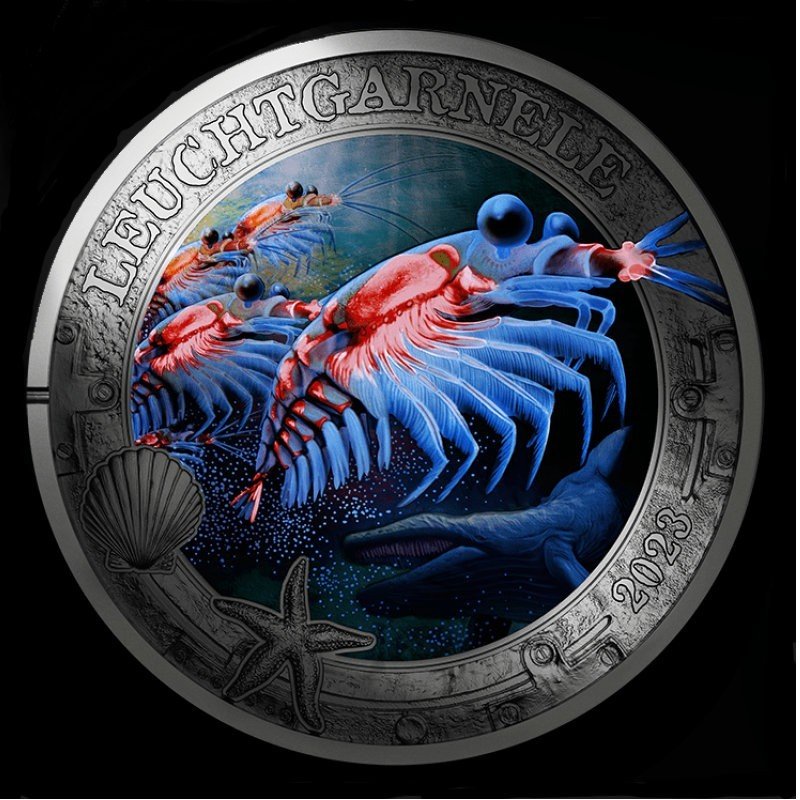
The reverse of the coin features a wide band resembling an ancient porthole, framing a water scene depicting Antarctic krill. When the reverse of the coin is illuminated with a special UV flashlight, the Antarctic krill stands out clearly in the center—its shell glimmers in yellow-orange, and its legs in light blue. As with all coins in this series, a shell and a starfish are visible on the left and bottom.
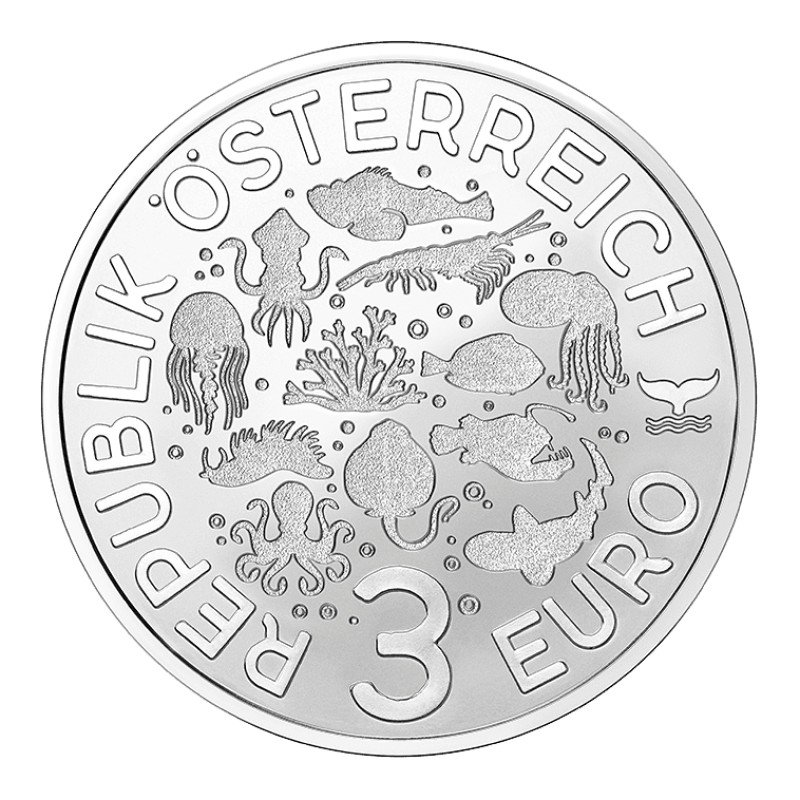
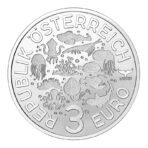
The obverse of the coin depicts silhouettes of all 12 magical sea creatures from the “Glowing Water World” series. Air bubbles rise among them, and the tail fin disappears beneath the waves on the right.
4 in stock
Antarctic krill is a small, swimming crustacean that lives in large swarms, sometimes reaching densities of 10,000–30,000 animals per cubic meter in the Southern Ocean’s Antarctic waters. It feeds directly on phytoplankton, mainly diatoms and other plant plankton. Antarctic krill directly ingest phytoplankton cells, a feat no other animal of krill’s size can achieve. This is accomplished using highly developed anterior legs that form an efficient filtering apparatus: six thoracopods (legs attached to the thorax) create a “feeding basket” used to collect phytoplankton from open water. In optimal conditions, the openings of this “basket” are only 1 μm in diameter. When food concentrations are lower, the open “feeding basket” is pushed half a meter through the water, and then algae are combed to the mouth opening with special bristles on the inner side of the thoracopods. Antarctic krill can also scrape the green ice algae lawn from the underside of drifting ice. Krill have developed special rake-like rows at the ends of their thoracopods and move in a zigzag pattern over the ice. In this way, a single krill can clean an area of about a square foot in approximately 10 minutes (1.5 cm2/s). Recent discoveries have shown that the ice algae layer is well developed over vast glacier areas, often containing much more carbon than the entire water column below. Krill find a significant energy source here, especially in spring when food sources are limited during the winter months.
Antarctic krill grow up to 6 centimeters (2.4 inches) long, weigh up to 2 grams (0.071 ounces), and can live up to six years. They are a key species in the Antarctic ecosystem and, by biomass, are one of the most abundant animal species on Earth. Antarctic krill are a staple in the diet of many other Antarctic marine animals, including whales, seals, fish, squid, penguins, albatrosses, and many other bird species.
Krill use an escape response to evade predators, swimming backward very quickly by flipping their tails. This swimming pattern is also known as lobstering. Krill can reach speeds greater than 0.6 meters per second (2.0 feet per second).
Krill are often referred to as light shrimp because they emit light through bioluminescent organs. These organs are located in various parts of the krill’s body: one pair near the eye stalk, another pair on the second and seventh thoracopods, and individual organs on four pleonsternites. These light organs emit yellow-green light periodically, for up to 2–3 seconds. They are considered so well-developed that they can be compared to a flashlight. At the end of the organ is a concave reflector, and at the front, a lens directs the emitted light. The entire organ can be rotated by muscles, allowing the light to be directed to a specific area. The function of these lights is not yet fully understood—some hypotheses suggest that the light helps to compensate for the krill’s shadow, preventing predators from seeing them from below, while others suggest that the glow plays an important role in mating or schooling at night.
| Weight | 0,02 kg |
|---|---|
| Dimensions | 0,3 × 0,1 × 0,05 cm |
| Country | |
| Year | |
| Denomination | |
| Quality | |
| Mintage |