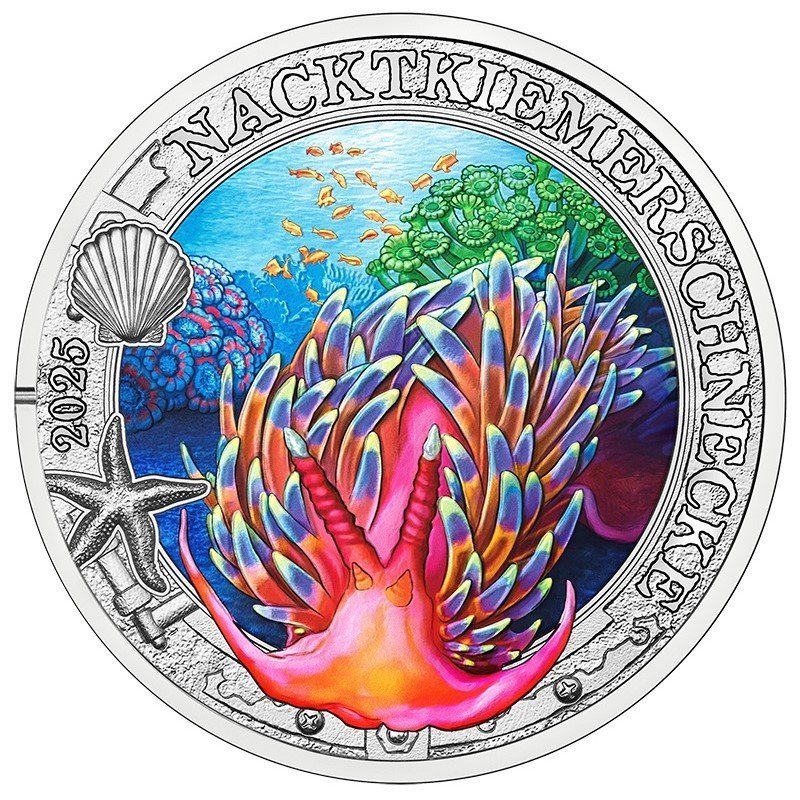
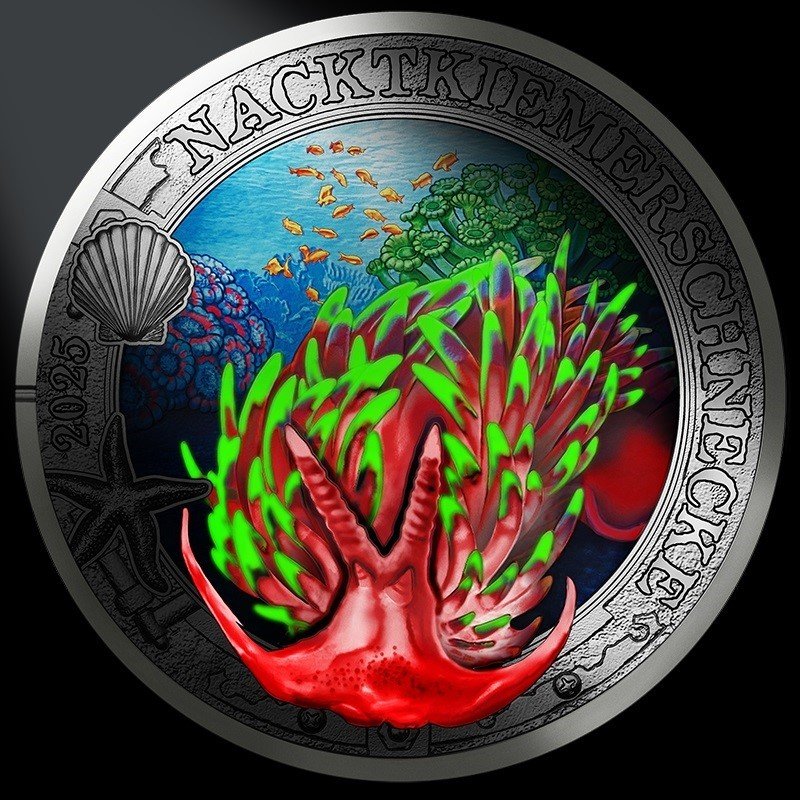
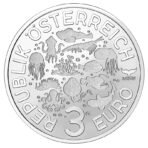
Austria 2025 3 euro colour collector coin – Sea slug

Austria 2025 3 euro colour collector coin glowing under UV light – Sea slug.
This is the eleventh coin in the “Glowing Water World” series.
The reverse of the coin features a wide band resembling an ancient porthole, framing an aquatic scene with a white sea slug at its center. In the background, a coral reef and a school of small fish can be seen.
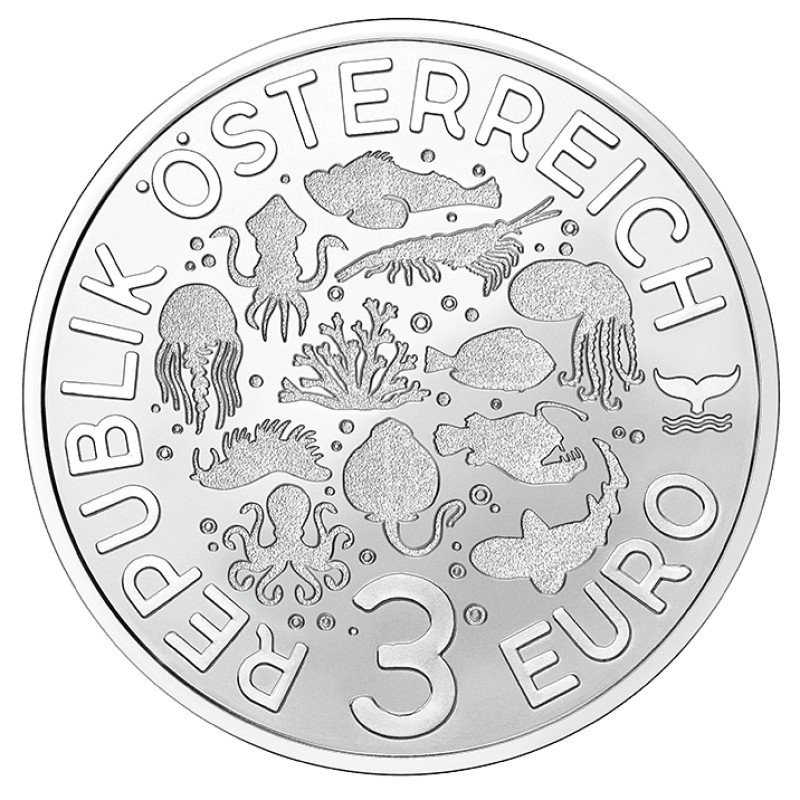
The obverse of the coin depicts silhouettes of all 12 magical sea creatures from the “Glowing Water World” series. Air bubbles rise among them, and the tail fin disappears beneath the waves on the right.
5 in stock
The sea slug depicted on the eleventh coin of the “Illuminating Marine Life” series fascinates with its eccentric shape and vibrant colors that change under ultraviolet light. It is believed that the dazzling color of many sea slug species serves as a warning signal to predators, enhanced by their ability to glow, especially at night, in deep water or caves and crevices. The human eye cannot perceive this biofluorescence, but many predatory fish can.
Sea slugs are not typical shelled mollusks that rely on their shell for protection. Instead, they use potent toxins, causing any fish attempting to swallow a sea slug to quickly spit it out. Additionally, sea slugs can even adopt the defense mechanisms of their prey, such as sea anemones, by assimilating highly toxic stinging cells from these flower-like animals’ polyps and storing them for future use. When threatened, they release the “stolen” stinging cells to deter their attacker.
Sea slugs are simultaneous hermaphrodites, meaning they possess both male and female reproductive structures. During mating, in an act known as “penis fencing,” two individuals compete for the male position by thrusting their penises at each other—the winner penetrates the other’s body wall and fertilizes it, forcing the other to take on the female role. The female lays eggs, which typically consist of thousands of tiny eggs resembling colorful flowers or garlands. These eggs hatch into larvae that drift in the sea as part of the plankton for a short time. At this early life stage, sea slugs still have a microscopic shell. Only when the larvae develop into small, bottom-dwelling slugs do they completely lose their tiny shell.
| Weight | 0,02 kg |
|---|---|
| Dimensions | 0,3 × 0,1 × 0,05 cm |
| Country | |
| Year | |
| Denomination | |
| Quality | |
| Mintage |